
Nicholas County Projected Release Dates
West Virginia's public prison interface uses the label “Projected Release Date.” WVDCR policy also uses “Minimum Discharge Date” or MDD for a scheduled date based on continuous incarceration with no loss of good time. The Parole Board uses MDD in some materials as well. Those labels are related, but they should not be swapped. Copy the term shown by each source.
A projection is built from the sentence and correctional calculation. It can change before release. The actual release date is the recorded day custody ended at that facility, whether through community release, parole, discharge, or transfer. A transfer closes one custody stay but is not freedom. For a Nicholas County case, the strongest record pairs the court's legal authority with WVDCR's custodial event.
A pretrial detainee at CRJCF has no sentence-based projected date. Bond, dismissal, plea, sentencing, and unresolved holds can control the outcome. Ask the Nicholas County court for the current order and CRJCF for the actual custody status.
Find Nicholas County Projected Release
Choose the source by custody type. WVDCR maintains separate jail and prison searches. The prison database is the proper first source for a person committed to state correctional custody. A Nicholas County pretrial or short-term regional-jail case requires the court order, credited time when sentenced, and CRJCF or WVDCR records. A federal sentence belongs in the BOP locator, not the state search.
- Identify whether the person is pretrial at CRJCF, serving a regional-jail sentence, committed to a WVDCR prison, or held under federal authority.
- For state prison custody, open the WVDCR prison offender search. The form requires at least four OID digits or at least three letters of both first and last name.
- Match the result by OID and identifying facts. Open the detail and copy “Projected Release Date” exactly, including “Not Available” if that is what appears.
- For a CRJCF sentence, obtain the Nicholas County sentencing order, the court's jail-credit finding, and WVDCR's current time sheet.
- Check for later court orders, consecutive terms, disciplinary adjustments, parole decisions, or another-agency holds.
- Confirm the actual exit through the WVDCR release or transfer record rather than the projection alone.
The Nicholas County release-record process gives the full route for former CRJCF detainees when the current roster no longer shows them.
Nicholas County Release Date Fields
An official West Virginia court-training source documents the prison result structure. The public detail can include OID, sex, birth date, height, weight, race, location, intake date, next parole hearing, Maximum Parole Discharge Date, Projected Release Date, sentencing county, offense, sentence, and a photograph when available. A field can say “Not Available.” That is not permission to estimate a date.
| Record field | Question it answers |
|---|---|
| Projected Release Date | The current public estimate shown by OIS for confinement release. |
| Maximum Parole Discharge Date | The possible end of parole supervision, not proof of prison custody. |
| Next parole hearing | A scheduled decision point, not a guaranteed release date. |
| Intake date and location | The state custody episode and current recorded institution. |
| Sentence and offense | The court term used in WVDCR's calculation. |
| Sentencing county | Connects the correctional record to the Nicholas County order. |
Note: A parolee may remain searchable because the prison database includes people under active WVDCR supervision.
Nicholas County Good-Time Calculation
West Virginia does not use a blanket rule requiring every prisoner to serve about 85 percent. Under West Virginia Code §15A-4-17, an eligible adult committed to the commissioner's custody generally receives one day of good time for each day incarcerated. The calculation includes jail days that the sentencing court credits. Life sentences and specified commitments are excluded, and the statute contains other limits.
Start with the maximum or fixed term in the court order. Add consecutive maximum terms where the law requires aggregation. Apply credited jail days, then the statutory good-time framework. WVDCR also accounts for any forfeiture after a disciplinary violation, later restoration, and limited extra credit for meritorious service or qualifying programs. The agency must provide a sentence and minimum-discharge statement and revise it when loss or restoration changes the earliest discharge.
The official good-time statute is shown in the captured source below.
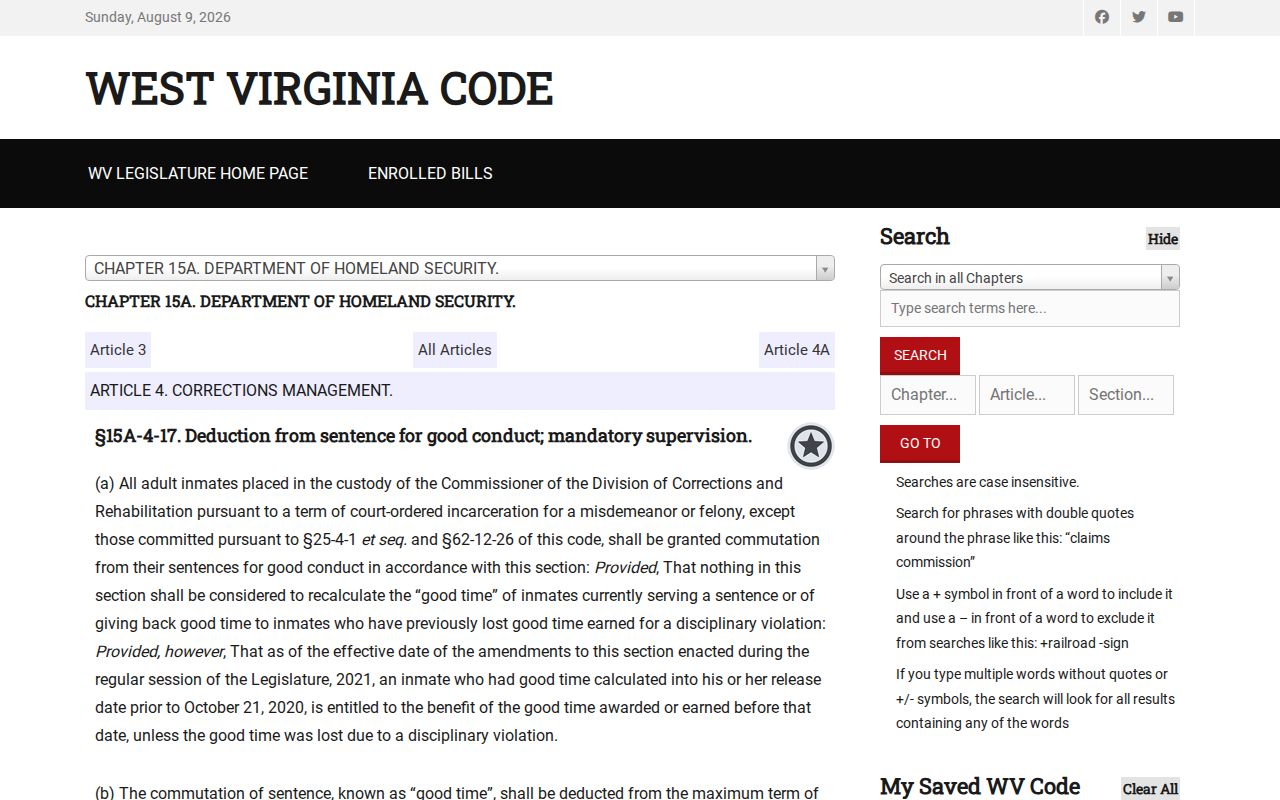
The statute supplies the framework. Only WVDCR's current time sheet applies all case-specific terms and changes to one person.
- Good time
- Statutory credit that can advance an eligible inmate's minimum discharge.
- Jail credit
- Presentence confinement days the sentencing court credits toward the term.
- Detainer
- A request or legal basis for another authority to take or continue custody.
- Minimum discharge date
- WVDCR's scheduled date if stated assumptions remain true.
Nicholas County Release Date Changes
A release projection is recalculated when its inputs change. Some changes alter the computed end of the sentence. Others affect whether the person can leave that facility or whether another custodian receives the person. Never force these events into one generic “delay” label.
| Factor | Effect on the date or release |
|---|---|
| Good-time forfeiture | Can move the earliest discharge later after discipline. |
| Good-time restoration | Can move the calculation again when WVDCR restores credit. |
| Jail-credit correction | Changes credited days under a corrected court finding or time sheet. |
| Consecutive sentence | Aggregates terms and changes the controlling maximum. |
| New or modified court order | Changes the legal sentence information used by WVDCR. |
| Detainer or warrant | May cause a handoff or continued custody even when one term ends. |
| Parole decision | May create conditional community release but does not itself record physical exit. |
Escape, revocation, and qualifying extra program credit can also affect the computation. No credit accrues while on parole or bond under the general rule described in the research. When two dates conflict, ask WVDCR for the revised statement and check the sentencing clerk for an amended order.
Nicholas County Jail-Credit Records
Jail credit connects the Nicholas County court order to WVDCR's time calculation. West Virginia Code §61-11-24 governs credit for time spent in jail before sentencing in the circumstances the statute covers. The sentencing court must supply the credited-days finding. WVDCR then uses that legal input in its official calculation. A person or outside database should not guess the credit from arrest and sentencing dates because breaks in custody, other charges, and the wording of the order can matter.
The West Virginia jail-credit statute is shown in the source capture below.
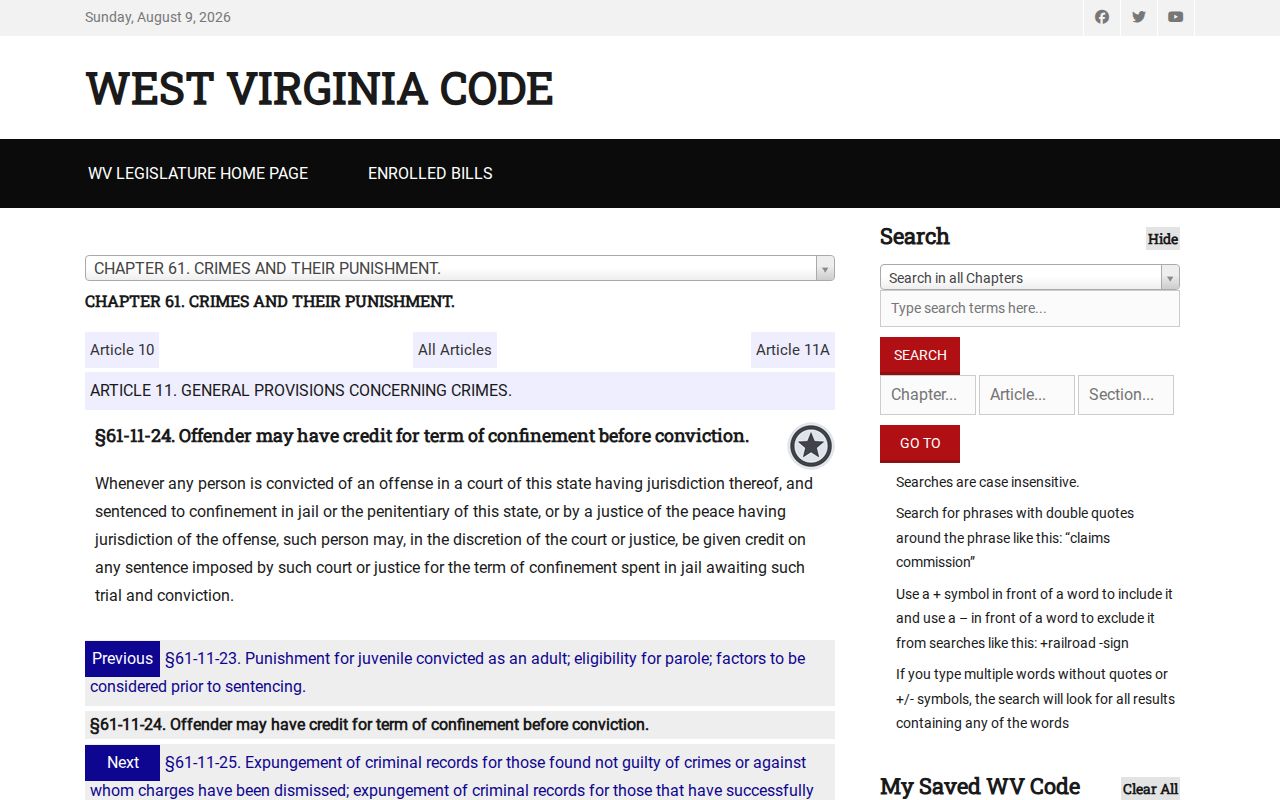
When the WVDCR time sheet and court order disagree, ask the Nicholas County sentencing clerk about the order and WVDCR about its computation. A legal challenge or correction belongs with counsel, the court, and the responsible agency.
Nicholas County Pretrial Release Timing
A person held at CRJCF before trial does not have a prison sentence from which WVDCR can compute a projected release date. The controlling events may be a bond order, payment or approval of bond, dismissal, plea, sentencing, or another hold. No fixed Nicholas County bail schedule was located. Nicholas magistrates set or accept bail under statewide rules, with forms that can include cash, secured recognizance, surety, own recognizance, or another judge-approved form.
Legal authorization and physical exit still occur in sequence. A docket entry showing bond does not prove CRJCF finished processing the person out. Check the Nicholas County Magistrate or Circuit Court for the order, then ask CRJCF for the actual release status or WVDCR record. If a second case, warrant, federal matter, or immigration detainer applies, one approved bond may not end custody.
Time served also needs both records. The sentencing order states the term and credited time, while WVDCR records when the facility processed release or transfer. Do not infer that the filing timestamp, bond payment, VINE alert, and physical exit occurred at the same moment.
Nicholas County Mandatory Release Supervision
Leaving confinement can precede the end of legal supervision. Section 15A-4-17 uses one year of accumulated good time to create one year of mandatory post-release supervision for enumerated cases involving specified violent, minor-victim, or firearm felonies committed on or after the statutory date. For other felony cases, a sentencing court may order up to 180 days of the sentence served through mandatory supervision.
West Virginia Code §15A-4-17a creates an additional mandatory supervised-release plan for certain eligible felonies. The mandatory supervised-release statute is captured below.
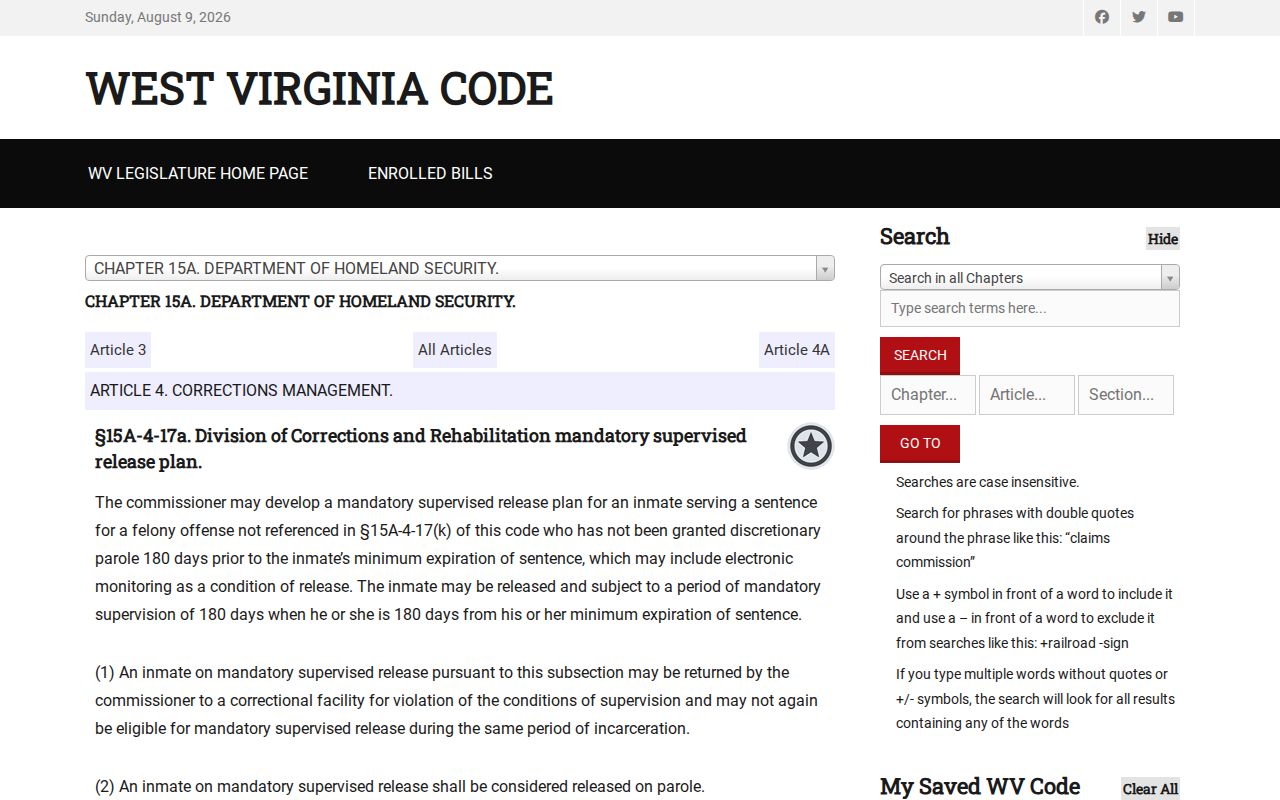
This framework explains why a physical release date and the end of corrections supervision can differ. Read the WVDCR status and discharge date as separate facts.
West Virginia Release-Date Calculation Quirks
West Virginia OIS uses “Projected Release Date,” while WVDCR policy and Parole Board material may use Minimum Discharge Date. Neither serves as an exit certificate. One-for-one statutory good time can change through loss, restoration, extra qualifying credit, corrected orders, and supervision rules. Parole eligibility is a different date and does not create a right to release.
A regional-jail parole grant has another local-system lag. The Parole Board FAQ says a person granted parole from a regional jail first transfers to a WVDCR facility for intake and fingerprinting. It advises anticipating seven to ten days between the grant and actual release. Nicholas County detainees at CRJCF therefore should not be described as released merely because the Board granted parole.
County or regional-jail sentences also should not be put through a generic online formula. Obtain the sentence, jail-credit finding, current WVDCR time sheet, and any later orders. Those records disclose the case inputs without asking an outside source to invent a date.
Confirm Nicholas County Release Dates
For state prison custody, record the OIS projection, then ask WVDCR for its current calculation when exact timing matters. For CRJCF, contact the facility or request the existing release or transfer record. The Nicholas Circuit or Magistrate Clerk supplies the sentence, bond, dismissal, revocation, or jail-credit order. Each record answers a different part of the question.
A Nicholas County VINELink release alert can add timely notice for CRJCF and state facilities. Transfer alerts may be held until arrival, and data can lag. Save the alert time, but verify the event with the custodian. A person who disappears from the live regional-jail search may have been released, transferred to prison, moved to another authority, or affected by a record delay.
Ask for the actual release date and time, release type or disposition, releasing authority, and transfer category when applicable. If the person remains on parole or mandatory supervision, preserve that status separately from the date confinement ended. That final distinction prevents a projected date, a Board decision, and a physical release from being treated as the same event.